 English ReNews
 Why Conflict Happens
Conflict often grows from incompatible goals, expectations, and values. Understanding those differences can replace hostility with a clearer way forward.
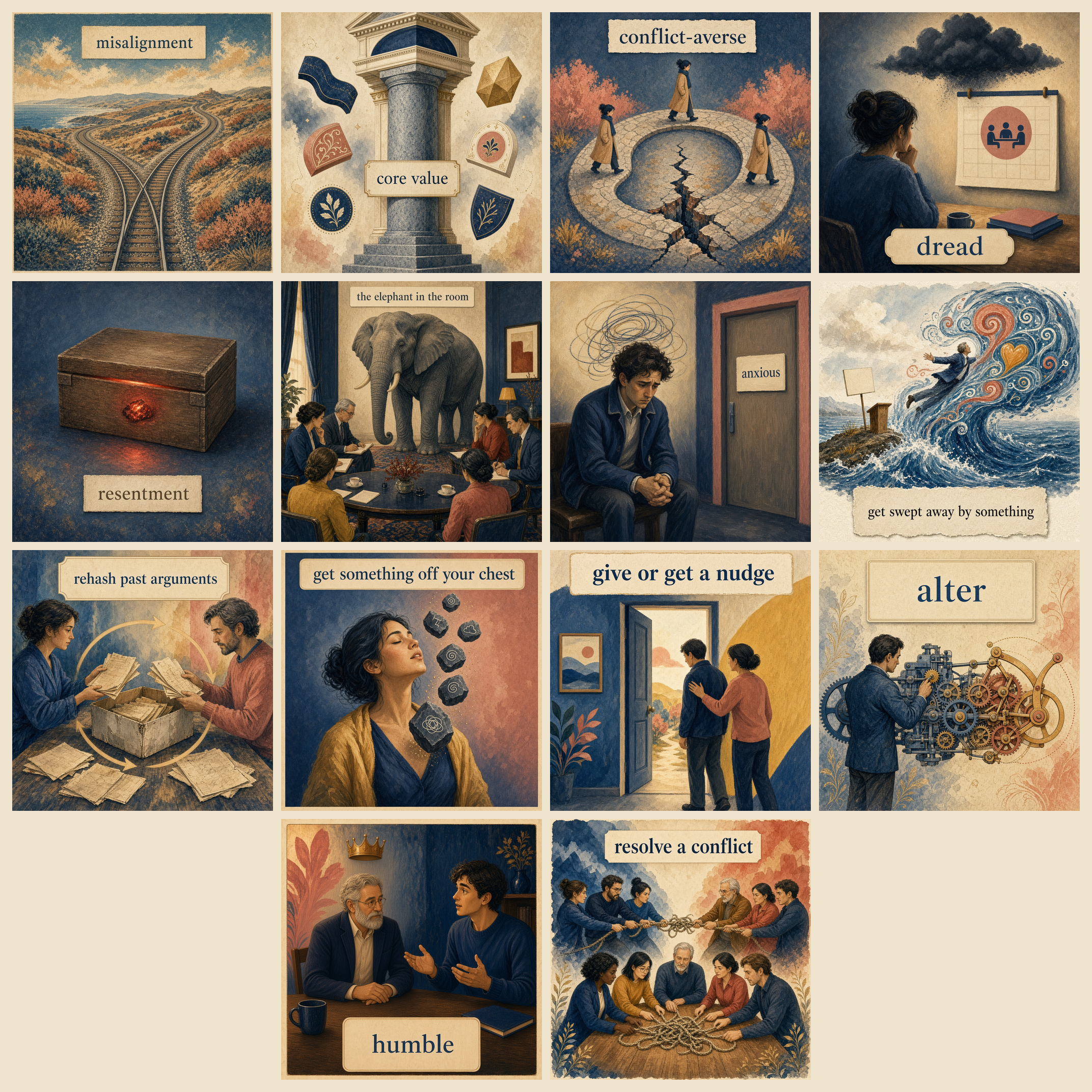
Conflict appears everywhere: in workplaces, schools, communities, and governments. It is often blamed on difficult personalities, but many disputes begin with a misalignment of goals, expectations, or responsibilities.
For example, a company may want to reduce costs while its employees want greater security. A city may support new housing while local residents want to protect green spaces. Both sides can have reasonable concerns, yet still disagree because they define success differently.
A practical dispute can become especially intense when it touches a core value, such as fairness, freedom, safety, or tradition. Once people feel that their values are threatened, compromise may appear like surrender.
Some leaders are conflict-averse and dread difficult discussions. They postpone decisions and hope tensions will disappear. Instead, silence often creates resentment, while the unresolved issue becomes the elephant in the room.
Public disagreement creates other problems. Participants may feel anxious and get swept away by anger. Instead of examining the present issue, they may rehash past arguments. Others simply want to get things off their chest, turning a discussion into a collection of complaints.
At such moments, participants may get a useful nudge from a moderator who can return their attention to the actual problem. Useful questions include: What facts do both sides accept? Which interests are negotiable? What consequences would each solution create?
Answers to these questions can alter how people understand the dispute. However, progress also requires participants to be humble enough to recognize weaknesses in their own position.
Resolving a conflict does not mean eliminating every disagreement. It means creating a fair process, making informed decisions, and finding a way forward. Sometimes the result is compromise; sometimes it is a firm boundary or an unpopular decision. Successful resolution does not require perfect agreement, but it should provide clarity without unnecessary hostility.
Vocabulary inspired by NPR Life Kit's article “How to fight with the people we care about”: https://www.npr.org/2026/09/09/nx-s1-5961264/conflict-and-relationships-comic-priya-parker. This educational article and its exercises are independently written.
Listen to the article
Tip: You can adjust the speed of the audio by clicking the 1.0x button.
Interesting words
These are the words that we think are interesting and worth learning.
Memory Method
A creative technique to help these words stick in your mind.
🧭 MISALIGNMENT
🔊 /ˌmɪs.əˈlaɪn.mənt/ (stress: LINE)
🧠 Visualization: Picture two railway tracks that should run together but gradually move in different directions. Each train follows its own track, so they can no longer arrive at the same destination.
Like what you've read?
Begin learning journeyWords stick best when you meet them again — and again, at just the right moments. That's why the Learning Journey brings you back to what you read at increasing intervals, so what you learn today actually stays with you.
How the Learning Journey Works
Word Matching
Right after reading
AI Chat Tasks
2 days later
Fill in the Blanks
2 weeks later
Fill in the Blanks
2 months later
Why create a free account?
Track your progress across every article you read
Get reminded exactly when it's time for your next review — spaced repetition, done for you
Get AI tutor feedback tailored to what you actually write
Completely free, forever — takes about 30 seconds to sign up