 English ReNews
 Swapping the Scroll for Something Real
As screen fatigue grows, some people are replacing endless online consumption with hobbies that offer calm, purpose, and visible results.
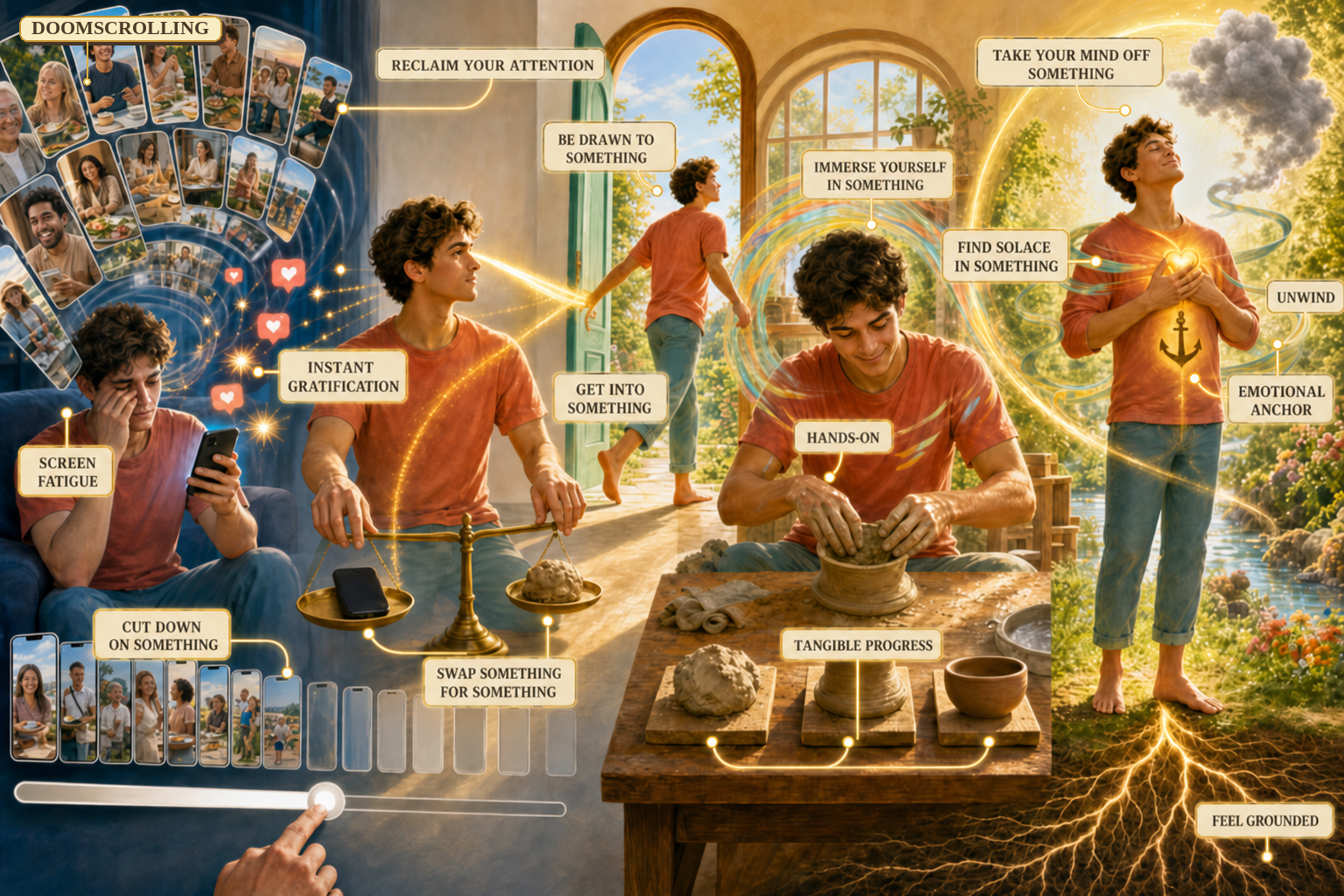
An evening online often begins with good intentions. Someone checks one message, watches a short video, and reads a few headlines. Before long, an hour has disappeared into doomscrolling. The phone has supplied plenty of information but little satisfaction, leaving the user with screen fatigue and a restless mind.
In response, some people are beginning to swap scrolling for hobbies. Their aim is not to reject technology completely. They simply want to cut down on passive screen time and reclaim their attention before every quiet moment is filled by a feed.
Hobbies offer a different kind of experience. Social media is designed around instant gratification: swipe, click, react, repeat. Most hobbies move more slowly. A sketch develops line by line, a meal takes time to prepare, and a song improves through regular practice. The reward is delayed, but it often feels more meaningful.
People are drawn to different activities. Some get into gardening or cooking, while others choose painting, knitting, photography, carpentry, or music. These hands-on pursuits encourage people to focus on what is directly in front of them. Once they immerse themselves in a task, the urge to check a notification can begin to fade.
Unlike an evening spent scrolling, a hobby frequently produces tangible progress. There may be fresh bread on the table, several pages of a novel, a repaired chair, or a song that sounds better than it did the week before. Even imperfect results provide evidence that time and effort have led somewhere.
The benefits are not limited to achievement. Repetitive, practical activities can help people unwind after work and take their minds off everyday pressures. Working with wood, soil, fabric, or paint can help them feel grounded, particularly when online life becomes noisy or overwhelming.
A hobby can also bring structure to an ordinary day. Someone living alone might find solace in evening piano practice, while a weekly dance class can become an emotional anchor by providing routine and familiar company.
Technology can still play a positive role. A person may discover a hobby through a video, learn a technique from an online teacher, or join a local group through social media. The important change comes when the screen becomes a doorway to an activity rather than the activity itself.
Replacing doomscrolling does not require expensive equipment or a dramatic lifestyle change. It can begin with a borrowed guitar, an inexpensive sketchbook, or a recipe made from ingredients already in the cupboard. The goal is not to become an expert. It is to spend less time consuming an endless stream and more time creating, practising, and paying attention to something real.
An independently written educational article inspired by the broader trend reported by the BBC: https://www.bbc.co.uk/news/articles/c4g4r4n3p02o. No quotations or personal accounts have been reproduced.
Listen to the article
Tip: You can adjust the speed of the audio by clicking the 1.0x button.
Interesting words
These are the words that we think are interesting and worth learning.
🎯 RECLAIM YOUR ATTENTION
🔊 /rɪˌkleɪm jər əˈten.ʃən/ (stress: CLAIM and TEN)
🧠 Visualization: Picture your attention as a bright beam being pulled in ten directions by notifications. You switch them off, take the beam back, and point it at one meaningful task.
🤝 Collocations:
- reclaim your attention from social media
- reclaim your time and attention
- pause to reclaim your attention
📍 Context: A modern, expressive phrase meaning to regain control of your focus. It is common in discussions about technology, productivity, study, and mental well-being.
✍️ Examples:
- Turning off nonessential alerts helped me reclaim my attention at work.
- She takes a walk at lunchtime to reclaim her attention before the afternoon meetings.
- Students put their phones in a drawer to reclaim their attention during revision.
🔥 Native-Speaker Tip: “Reclaim” suggests taking back something that outside demands had gradually taken away.
🌊 IMMERSE YOURSELF IN SOMETHING
🔊 /ɪˈmɜːs jəˈself ɪn ˌsʌm.θɪŋ/ (stress: MERSE and SELF; US /ɪˈmɝːs/)
🧠 Visualization: Imagine stepping into a clear pool until the water surrounds you completely. Now replace the water with music, a book, or a project that holds all your attention.
🤝 Collocations:
- immerse yourself in a book
- immerse yourself in a new culture
- become immersed in a project
📍 Context: A neutral-to-formal expression for becoming deeply involved in an activity or experience. The reflexive form normally takes “in.”
✍️ Examples:
- On holiday, he immersed himself in a detective novel.
- Living with a host family allowed Mina to immerse herself in the local culture.
- I became so immersed in the design project that I forgot to check the time.
⚠️ Common Mistake: Say “immerse yourself in something,” not “immerse yourself into something.”
📈 TANGIBLE PROGRESS
🔊 /ˌtæn.dʒə.bəl ˈprəʊ.ɡres/ (stress: TAN and PRO; US /ˈprɑː.ɡres/)
🧠 Visualization: See a half-built wooden chair beside yesterday’s pile of loose boards. The visible change proves that your effort has produced a real result.
🤝 Collocations:
- make tangible progress
- show tangible progress
- see tangible progress
📍 Context: A useful phrase for improvement that is clear, measurable, or visible. It appears naturally in work, education, fitness, recovery, and personal projects.
✍️ Examples:
- After weeks of negotiation, the two sides finally made tangible progress.
- She is making tangible progress with her pronunciation.
- By Sunday evening, we could see tangible progress on the renovation.
🔥 Native-Speaker Tip: “Tangible” literally means touchable, but it commonly describes results or benefits that are clear and real.
🌳 FEEL GROUNDED
🔊 /ˌfiːl ˈɡraʊn.dɪd/ (stress: GROUNDED)
🧠 Visualization: Picture yourself standing barefoot on firm earth while noise and loose papers swirl around you. Your feet remain steady and your breathing slows.
🤝 Collocations:
- help someone feel grounded
- feel calm and grounded
- stay grounded
📍 Context: An everyday metaphor meaning to feel calm, stable, present, and connected to reality. It is common in conversations about stress and emotional well-being.
✍️ Examples:
- Cooking for my family helps me feel grounded after a difficult week.
- Before the interview, she took several slow breaths to feel more grounded.
- Familiar routines helped the children stay grounded after the move.
🔥 Native-Speaker Tip: “Stay grounded” can also mean remain sensible and modest despite success.
⚡ INSTANT GRATIFICATION
🔊 /ˌɪn.stənt ˌɡræt.ɪ.fɪˈkeɪ.ʃən/ (stress: IN and KAY)
🧠 Visualization: Imagine pressing a bright button and receiving a sweet immediately, while a second reward requires patient work for several weeks.
🤝 Collocations:
- seek instant gratification
- offer instant gratification
- culture of instant gratification
📍 Context: A neutral-to-critical phrase for pleasure or satisfaction received immediately, without waiting or sustained effort. It is used when discussing spending, food, entertainment, technology, and self-control.
✍️ Examples:
- Online shopping offers instant gratification, but the bills arrive later.
- Learning an instrument requires patience rather than instant gratification.
- The game was designed to provide constant instant gratification through small rewards.
⚠️ Common Mistake: Gratification means satisfaction or pleasure, not gratitude.
🔄 SWAP SOMETHING FOR SOMETHING
🔊 /ˌswɒp ˌsʌm.θɪŋ fə ˌsʌm.θɪŋ/ (stress: SWAP; US /swɑːp/)
🧠 Visualization: See two objects on a balance: you remove a phone from one side and replace it with a paintbrush.
🤝 Collocations:
- swap coffee for tea
- swap a car for a bicycle
- swap screen time for exercise
📍 Context: A common, informal expression meaning to replace or exchange one thing for another. It works for objects, habits, choices, and activities.
✍️ Examples:
- I swapped my usual bus journey for a walk through the park.
- The restaurant lets customers swap chips for a side salad.
- She swapped a secure office job for the uncertainty of freelance work.
⚠️ Common Mistake: When describing replacement, use “swap A for B”: A is removed and B takes its place.
📉 CUT DOWN ON SOMETHING
🔊 /ˌkʌt ˈdaʊn ɒn ˌsʌm.θɪŋ/ (stress: DOWN; US /ɑːn/)
🧠 Visualization: Picture a weekly bar chart shrinking as you gradually reduce the hours spent on an unwanted habit.
🤝 Collocations:
- cut down on sugar
- cut down on spending
- cut down on screen time
📍 Context: A very common phrasal verb meaning to reduce the amount or frequency of something, without necessarily stopping completely.
✍️ Examples:
- We are eating at home more often to cut down on spending.
- His doctor advised him to cut down on salty food.
- I deleted two apps to cut down on unnecessary notifications.
⚠️ Common Mistake: “Cut down on” means reduce; “cut out” often means stop completely.
🌱 GET INTO SOMETHING
🔊 /ˌɡet ˈɪn.tuː ˌsʌm.θɪŋ/ (stress: IN)
🧠 Visualization: Imagine opening the door to a pottery studio out of curiosity, then returning every week because you have begun to love it.
🤝 Collocations:
- get into gardening
- get into photography
- really get into a book
📍 Context: An informal and highly reusable expression meaning to become interested or involved in an activity, subject, or habit.
✍️ Examples:
- I got into running after a colleague invited me to a local club.
- It took several chapters, but then I really got into the novel.
- How did you get into software development?
🔥 Native-Speaker Tip: “Get into” can also mean enter a place or be accepted by an institution, so context determines the meaning.
📱 DOOMSCROLLING
🔊 /ˈduːmˌskrəʊ.lɪŋ/ (stress: DOOM; US /ˈduːmˌskroʊ.lɪŋ/)
🧠 Visualization: See a thumb moving endlessly past one alarming headline after another while the room grows darker and the clock races forward.
🤝 Collocations:
- late-night doomscrolling
- stop doomscrolling
- get caught up in doomscrolling
📍 Context: A modern informal noun for repeatedly reading negative or alarming online content, even when doing so makes you feel worse.
✍️ Examples:
- Late-night doomscrolling made it difficult for her to sleep.
- I opened the news for one update and fell into an hour of doomscrolling.
- Setting a time limit helped him stop doomscrolling before bed.
🔥 Native-Speaker Tip: Ordinary endless scrolling is not always doomscrolling; the “doom” specifically refers to disturbing or worrying content.
👀 SCREEN FATIGUE
🔊 /ˈskriːn fəˌtiːɡ/ (stress: SCREEN and TIG)
🧠 Visualization: Picture tired eyes, tense shoulders, and a fading attention meter after a day of video calls, documents, messages, and scrolling.
🤝 Collocations:
- experience screen fatigue
- reduce screen fatigue
- symptoms of screen fatigue
📍 Context: A widely understood phrase for physical or mental tiredness associated with prolonged screen use. It can include tired eyes, poor concentration, headaches, or general exhaustion.
✍️ Examples:
- Regular breaks can reduce screen fatigue during a long working day.
- By the final video call, everyone was showing signs of screen fatigue.
- She printed the report because screen fatigue was making careful reading difficult.
⚠️ Common Mistake: “Screen fatigue” is a descriptive expression, not a precise medical diagnosis.
🔥 Native-Speaker Tip: “Digital fatigue” is broader and can include exhaustion from constant messages, platforms, and online demands.
🌙 UNWIND
🔊 /ʌnˈwaɪnd/ (stress: WIND)
🧠 Visualization: Imagine a tightly wound spring slowly loosening as you change clothes, make tea, and settle into a peaceful evening.
🤝 Collocations:
- unwind after work
- time to unwind
- relax and unwind
📍 Context: A common verb meaning to relax gradually after work, effort, excitement, or stress.
✍️ Examples:
- I listen to music on the train to unwind after work.
- The hotel has a quiet garden where guests can unwind.
- It took him a while to unwind after the intense competition.
⚠️ Common Mistake: In this meaning, “unwind” is intransitive: people unwind; an activity helps them unwind.
🧲 BE DRAWN TO SOMETHING
🔊 /bi ˈdrɔːn tə ˌsʌm.θɪŋ/ (stress: DRAWN)
🧠 Visualization: Picture a gentle magnet pulling you toward one colourful book in a large shop before you know anything about its story.
🤝 Collocations:
- naturally drawn to
- feel drawn to
- drawn to creative work
📍 Context: A neutral expression meaning to feel attracted to or interested in someone or something, often without a fully conscious reason.
✍️ Examples:
- She has always been drawn to jobs that involve helping people.
- Visitors were drawn to the warm light coming from the café.
- I felt drawn to the course because it combined science with design.
⚠️ Common Mistake: Here, “drawn” is the past participle of “draw,” not an adjective meaning tired-looking.
👐 HANDS-ON
🔊 /ˌhændzˈɒn/ (stress: ON; US /ˌhændzˈɑːn/)
🧠 Visualization: See a learner putting away a manual and using both hands to assemble, test, and adjust a small machine.
🤝 Collocations:
- hands-on experience
- hands-on activity
- hands-on approach
📍 Context: A common adjective for practical participation rather than passive observation or purely theoretical study. It is frequent in education and work.
✍️ Examples:
- The course includes hands-on experience with professional camera equipment.
- Young children often learn best through hands-on activities.
- Our manager takes a hands-on approach when a project is in trouble.
⚠️ Common Mistake: Use a hyphen before a noun: “a hands-on workshop.”
🎈 TAKE YOUR MIND OFF SOMETHING
🔊 /ˌteɪk jə ˈmaɪnd ɒf ˌsʌm.θɪŋ/ (stress: MIND and OFF; US /ɔːf/)
🧠 Visualization: Picture a heavy worry written on a balloon. A lively game carries the balloon away for a while, giving your mind room to rest.
🤝 Collocations:
- take your mind off work
- take your mind off your worries
- help take your mind off something
📍 Context: A natural conversational expression meaning to distract yourself temporarily from a worry, pain, or demanding situation.
✍️ Examples:
- We watched a comedy to take our minds off the delayed flight.
- A short puzzle helped take her mind off the dental procedure.
- Let’s go for lunch and take your mind off work for an hour.
⚠️ Common Mistake: Change the possessive for the person: “my mind,” “your mind,” “her mind,” or “their minds.”
🕯️ FIND SOLACE IN SOMETHING
🔊 /ˌfaɪnd ˈsɒl.ɪs ɪn ˌsʌm.θɪŋ/ (stress: SOL; US /ˈsɑː.lɪs/)
🧠 Visualization: Imagine sitting beside a warm lamp with a familiar book while a storm continues outside. The storm remains, but the book gives you comfort.
🤝 Collocations:
- find solace in music
- a source of solace
- find solace in familiar routines
📍 Context: A thoughtful, somewhat literary expression for receiving comfort during sadness, loneliness, disappointment, or difficulty.
✍️ Examples:
- After the disappointing result, she found solace in long walks by the sea.
- Many people find solace in music during uncertain periods.
- He found solace in the support of friends who understood his situation.
🔥 Native-Speaker Tip: Solace comforts you during genuine difficulty; for ordinary relaxation, “comfort” or “enjoyment” is usually more natural.
⚓ EMOTIONAL ANCHOR
🔊 /ɪˌməʊ.ʃən.əl ˈæŋ.kə/ (stress: MO and AN; US /ɪˌmoʊ.ʃən.əl ˈæŋ.kɚ/)
🧠 Visualization: See a small boat held safely in place by an anchor while strong waves move the water around it.
🤝 Collocations:
- provide an emotional anchor
- become an emotional anchor
- serve as an emotional anchor
📍 Context: A modern metaphor for a person, place, activity, belief, or routine that provides emotional stability during change or uncertainty.
✍️ Examples:
- Their weekly family dinner became an emotional anchor after the move.
- For the touring musician, morning exercise provides an emotional anchor.
- The old neighbourhood café served as an emotional anchor for many residents.
🔥 Native-Speaker Tip: The phrase suggests dependable stability over time, not merely a brief distraction.
Like what you've read?
Begin learning journeyWords stick best when you meet them again — and again, at just the right moments. That's why the Learning Journey brings you back to what you read at increasing intervals, so what you learn today actually stays with you.
How the Learning Journey Works
Word Matching
Right after reading
AI Chat Tasks
2 days later
Fill in the Blanks
2 weeks later
Fill in the Blanks
2 months later
Why create a free account?
Track your progress across every article you read
Get reminded exactly when it's time for your next review — spaced repetition, done for you
Get AI tutor feedback tailored to what you actually write
Completely free, forever — takes about 30 seconds to sign up