
Learn English Through Articles

Health

Lindsay Clancy: A Case Without a Simple Answer

A deadlocked jury left Lindsay Clancy’s criminal responsibility unresolved. The case exposes the uneasy boundary between severe postpartum mental illness and legal accountability.
2026-10-08

When Lindsay Clancy’s trial hit the news, it raised a whole slew of questions about mental illness and criminal responsibility.

On January 24, 2023, Clancy killed her three young children inside their Massachusetts home before jumping from a second-story window. She survived but was left paralyzed.

It was an unfathomable act. However, the most contentious point at trial was whether postpartum psychosis had prevented Clancy from understanding that her actions were wrong.

Prosecutors argued that she had planned the killings and remained aware of reality. The defense pushed back, presenting expert testimony that she had been experiencing postpartum psychosis at the time.

The insanity defense is not simply a request for leniency. It asks whether mental illness made the defendant legally incapable of being held responsible.

The evidence offered no clear-cut answer. A person may perform ordinary tasks while experiencing a severely distorted sense of reality. Mothers with frightening symptoms may also be wary of discussing them because they fear judgment, hospitalization, or separation from their children.

After more than 38 hours of deliberation, the jury remained divided. Eleven jurors reportedly favored finding Clancy not criminally responsible, while one disagreed. The judge declared a mistrial on September 4, 2026.

Prosecutors initially held off on announcing their next step. They still had to decide whether to opt for another trial.

The case demands compassion, but compassion should not erase accountability or the suffering of Clancy’s children.

The trial could become a watershed moment in how postpartum mental healthcare is discussed. Once public attention moves elsewhere, maternal mental health cannot be placed on the back burner again.

The law may eventually determine Clancy’s responsibility. It cannot provide a simple explanation for how an ordinary family life ended in extraordinary tragedy.

Based on public facts reported by Reuters (https://www.reuters.com/world/us/deadlocked-jury-lindsay-clancys-murder-trial-deliberate-seventh-day-2026-09-04/) and WBUR (https://www.wbur.org/news/2026/09/04/lindsay-clancy-murder-trial-verdict-massachusetts). This educational article and its exercises are independently written.

Listen to the article

Tip: You can adjust the speed of the audio by clicking the 1.0x button.

Interesting words

These are the words that we think are interesting and worth learning.

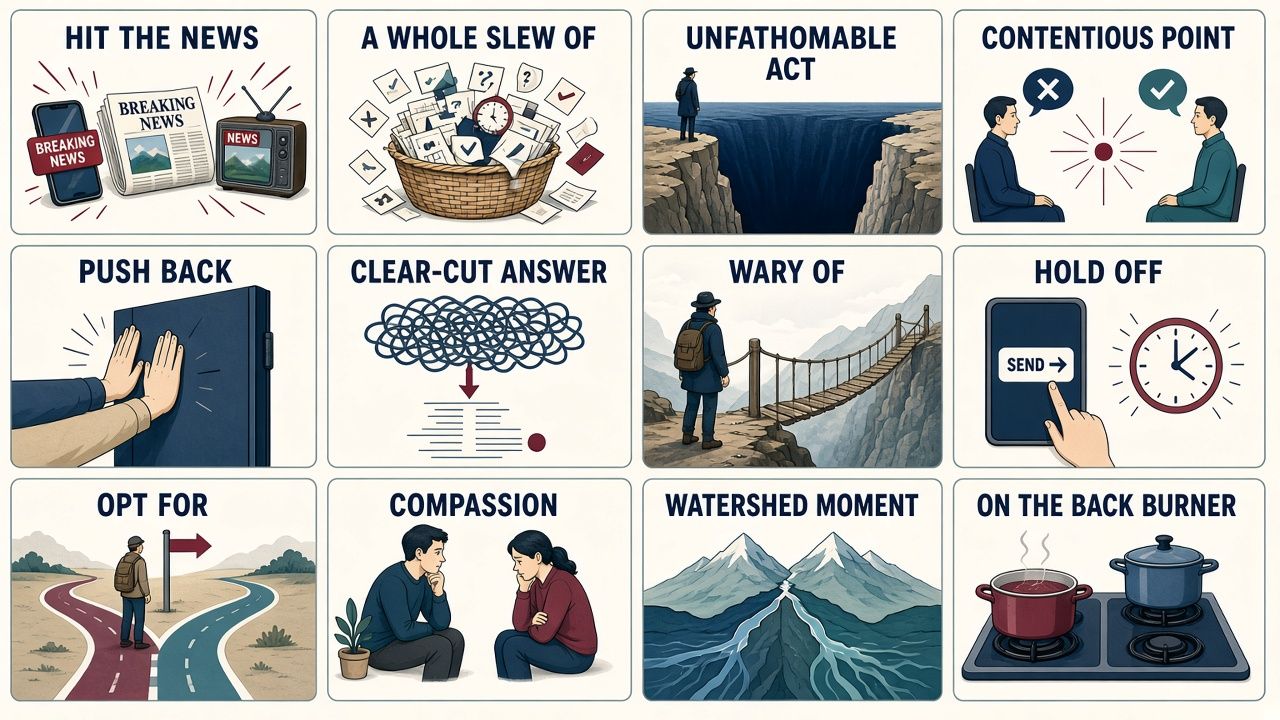
hit the news
to receive a lot of attention and be reported in the news
B1 · Informal — Common in everyday conversation and casual news discussion.
Alternatives: make the news,be in the news
Use 'hit the news' or 'make the news' for a more informal tone, and 'be in the news' for a more neutral or formal tone
a whole slew of
a large number of things, often used to describe a multitude of problems, issues, or questions
B2 · Semi-formal — Common in news reports, social media, and everyday talk about current events.
Alternatives: a host of,a multitude of,a plethora of
Use 'a whole slew of' in informal contexts to describe a large number of things, especially problems or questions. 'A host of', 'a multitude of', and 'a plethora of' can be used in both formal and informal contexts, but 'a whole slew of' is more colloquial.
unfathomable act
An extremely difficult or impossible thing to understand or explain.
C1 · Formal — Suitable for serious news articles, academic discussions, and formal writing.
Alternatives: inconceivable,unthinkable,baffling
Use 'unfathomable act' for a shocking or inexplicable crime, 'inconceivable' for something hard to believe, and 'unthinkable' for something too terrible to consider.
contentious point
a topic or issue that causes disagreement or controversy
B2 · Formal — Suitable for news articles, editorials, and academic writing.
Alternatives: contentious issue,point of dispute
Use 'contentious point' in formal or written contexts, while 'point of contention' is suitable for both formal and informal situations. 'Contentious issue' is often used when discussing politics or social issues.
push back
to postpone or move back a scheduled event or decision
B2 · Semi-formal — Common in news reports, business meetings, and everyday conversations.
Alternatives: postpone,delay,defer
Use 'push back' when you want to delay something that was previously planned, whereas 'postpone' and 'delay' can be used in similar situations but 'push back' often implies a stronger sense of resistance or objection.
clear-cut answer
A clear-cut answer is a decision or conclusion that is very obvious and not open to interpretation.
B2 · Semi-formal — Common in news reports, social media, and everyday talk about current events.
Alternatives: definite answer,straightforward answer,obvious answer
Use 'clear-cut answer' when the solution or decision is straightforward and not open to debate, but 'definite answer' might be used in more formal situations or when emphasizing finality.
wary of
Being wary of something means being cautious or vigilant about it, often because it may be a threat or have negative consequences.
B2 · Semi-formal — Common in news reports, social media, and everyday talk about current events.
Alternatives: cautious of,suspicious of,apprehensive of
Use 'wary of' when describing a general feeling of caution or concern about something, while 'cautious of' is more about taking specific precautions; 'suspicious of' implies a stronger sense of distrust.
hold off
to postpone or put off something, often in order to gain more time or to avoid doing something unpleasant
B1 · Informal — Common in everyday conversations and informal writing.
Alternatives: put off,postpone,defer
Use 'hold off' when you want to emphasize delaying a decision or action, often due to uncertainty or to avoid a difficult situation; use 'put off' and 'postpone' in more general situations, and 'defer' in formal or official contexts
opt for
to decide on or select something from a range of possibilities
B2 · Semi-formal — Common in news reports, formal discussions, and everyday talk about decisions.
Alternatives: select,decide on,go for
Use 'opt for' in formal or semi-formal contexts, especially when discussing choices or decisions made by individuals or groups; use 'choose' in more casual conversations
compassion
a feeling of sympathy and concern for someone who is suffering
B2 · Semi-formal — Common in news reports, formal discussions, and everyday conversations about social issues.
Alternatives: sympathy,pity,kindness
Use 'compassion' when describing a deeper understanding and sharing of another's feelings, especially in a situation where someone is suffering; use 'sympathy' for a more general feeling of pity or condolence, and 'empathy' when specifically sharing another's feelings
watershed moment
A significant event or point in time that marks a major change or shift in a situation or process.
B2 · Semi-formal — Common in news reports, formal discussions, and social media.
Alternatives: watershed,milestone,tipping point
Use 'watershed moment' or 'watershed' for formal or news contexts; 'turning point' for everyday conversations; 'milestone' for achievements; and 'tipping point' for situations that lead to sudden change.
on the back burner
to stop or delay a plan or activity, often temporarily
B2 · Semi-formal — Common in news reports, social media, and everyday talk about current events.
Alternatives: on ice,put on hold,set aside
Use 'on the back burner' when referring to plans or projects that are being temporarily set aside, often due to other priorities or circumstances. 'On ice' can also work in informal contexts, while 'put on hold' might be more commonly used in professional settings.

Like what you've read?

Begin learning journey

Words stick best when you meet them again — and again, at just the right moments. That's why the Learning Journey brings you back to what you read at increasing intervals, so what you learn today actually stays with you.

How the Learning Journey Works

1

Movie Connection

Right after reading

2

Fill in the Blanks

The next day

3

AI Chat Tasks

2 days later

4

Fill in the Blanks

2 weeks later

5

Fill in the Blanks

2 months later

Why create a free account?

Track your progress across every article you read

Get reminded exactly when it's time for your next review — spaced repetition, done for you

Get AI tutor feedback tailored to what you actually write

Create your own Custom Journey from any words you want to learn — with a story, audio and exercises

Completely free, forever — takes about 30 seconds to sign up

Support Us

A Project of Love

English ReNews is crafted with care by a small, passionate team that believes learning a language should feel like discovering the world. We curate real news stories to help you grow your English — naturally and joyfully.

We operate without corporate sponsors or paywalls. Every article you read is made possible by the generosity of readers like you. If our work has value to you, please consider supporting us — any amount helps us continue this labor of love.