
Learn English Through Articles

Career

Is the Career Ladder Still the Goal?

Careers rarely follow the plan. Six common questions about promotions, side steps, and starting again, with plain answers.
2026-10-12

Careers rarely go the way people planned. Here are six questions that keep coming up when they don’t.

Do people still want to climb the corporate ladder?

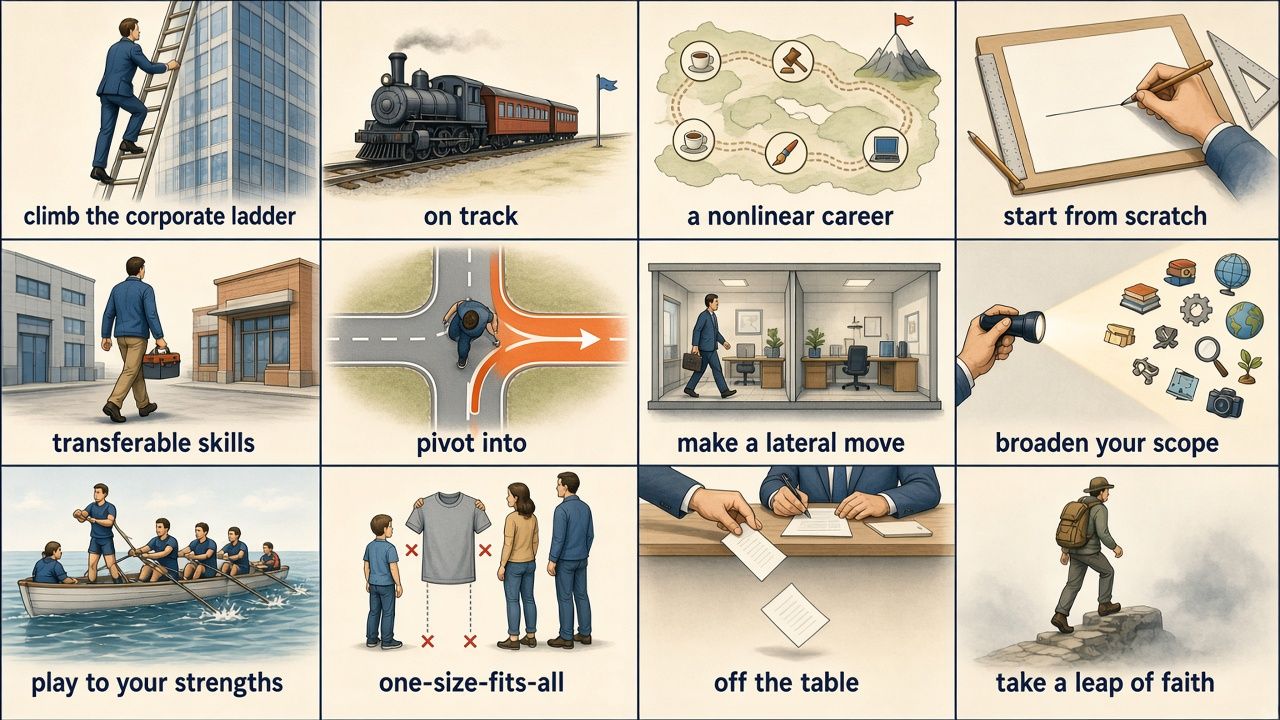
Some do, and there is nothing wrong with that. If you like staying with one company, following a clear path, and a bigger title every few years, a series of promotions can suit you well. But climbing the corporate ladder is no longer the only way to define success. Many people now judge a job by what it teaches them, not only by rank.

How do I know I'm on track?

You are on track when you are meeting the goals you set for yourself. A friend's promotion at thirty says very little about your own plan. Once or twice a year, write down where you hoped to be, where you are now, and what has changed.

Do I have to start from scratch if I change fields?

Not really. Even a big change rarely means you start from scratch. Running a busy kitchen, teaching a class, or tracking the budget for a local club all build transferable skills, such as planning, communication, and staying calm under pressure. Those skills go with you.

What are my options besides a promotion?

There are two common ones. You can pivot into a different field, the way a nurse might move into health technology. Or you can make a lateral move: a job at the same level, but with a new team, city, or set of tasks. Neither brings a bigger title right away, yet a sideways step can teach you things a promotion would not.

How do I choose a direction?

Look for work that lets you play to your strengths. Ask which tasks make the hours pass quickly and what colleagues come to you for. Be wary of one-size-fits-all advice, because what worked for a parent or a famous CEO may not suit your life. And some options will be off the table for practical reasons, such as rent or a family to support. That’s normal, and it narrows the search.

What if I'm not sure it will work?

Often you won’t be. Any real change means taking a leap of faith. You can lower the risk by talking to people who already do the job, or by trying a short course or a small project before you quit.

A career with a few turns in it isn’t a failure. For many people, that is simply what a curious working life looks like.

Inspired by the TED talk “The best career path isn’t always a straight line” by Sarah Ellis and Helen Tupper: https://www.youtube.com/watch?v=1ALfKWG2nmw. This educational article and its exercises were independently written.

Listen to the article

Tip: You can adjust the speed of the audio by clicking the 1.0x button.

Interesting words

These are the words that we think are interesting and worth learning.

climb the corporate ladder
to progress and achieve success in a business or organization, often by getting promoted to higher positions
B2 · Semi-formal — Common in business news, professional development articles, and formal career advice.
Alternatives: get ahead,move up,rise through the ranks
Use 'climb the corporate ladder' for a more formal or traditional tone, often in a business or professional setting; use 'get ahead' or 'move up' in informal conversations or when referring to personal progress in various fields.
on track
making progress according to a plan or schedule
B2 · Semi-formal — Common in business, education, and everyday conversations.
Alternatives: on schedule,on course,ahead of schedule
Use 'on track' in informal and formal contexts to describe progress, 'on schedule' for time-sensitive projects, and 'on course' for educational or training programs.
start from scratch
to start something without using any existing work or advantages, often because previous efforts have failed or been lost
B2 · Semi-formal — Common in everyday talk, business discussions, and casual writing.
Alternatives: from square one,begin anew
Use 'start from scratch' in informal situations and when emphasizing the lack of existing resources or knowledge. 'Begin from nothing' is less common but can be used in similar contexts. 'From square one' is often used in business or project management contexts.
transferable skills
Skills that can be applied to different jobs or industries, remaining relevant and valuable.
B2 · Semi-formal — Common in career development articles, professional networking, and everyday talk about career planning.
Alternatives: transferable skills,portable skills,universal skills
Use 'transferable skills' in formal or professional contexts, such as career development or education; 'portable skills' in more casual conversations or when emphasizing the skills' versatility.
pivot into
to change direction or focus, often suddenly or unexpectedly, in a career or life path
B2 · Semi-formal — Common in career development articles, professional networking, and everyday conversations about changing life paths.
Alternatives: transition into,move into,turn to
Use 'pivot into' when describing a significant change in direction, often in a professional or career context. Use 'transition into' for more general changes, 'move into' for physical or positional changes, and 'turn to' for seeking help or advice.
make a lateral move
to make a move to a different position or career path, often within the same industry or company, that is not a traditional or expected progression
B2 · Semi-formal — Common in business and career development articles, interviews, and discussions.
Alternatives: make a career change,switch tracks,pivot
Use 'make a lateral move' in a professional context to describe a move to a different role or department within the same company or industry, often at a similar level of responsibility. Use 'change direction' or 'switch tracks' for more general career changes. 'Pivot' is often used for more drastic changes.
play to your strengths
to use your skills and abilities to your advantage, especially in a challenging situation
B2 · Semi-formal — Common in career advice, self-improvement, and everyday talk about personal development.
Alternatives: play to your strengths,capitalize on your strengths,maximize your strengths
Use 'play to your strengths' in informal and conversational contexts, while 'capitalize on your strengths' is suitable for more formal situations; both phrases are commonly used in career development and self-improvement discussions
one-size-fits-all
A single solution or approach that is expected to work for everyone, regardless of individual differences.
B1 · Formal — Suitable for business articles, editorials, and professional discussions.
Alternatives: one-size-fits-all approach,universal approach
Use 'one-size-fits-all' when describing a solution that doesn't account for individual differences, and 'universal solution' or 'one-size-fits-all approach' in more formal contexts.
off the table
no longer considered or accepted as a possibility
B2 · Semi-formal — Common in news reports, social media, and everyday talk about current events.
Alternatives: ruled out,not an option
Use 'off the table' when you want to convey that something is no longer being considered or is no longer possible, while 'ruled out' is often used in more formal or official situations.
take a leap of faith
to make a decision and do something without being completely sure of the outcome
B2 · Semi-formal — Common in news reports, social media, and everyday talk about current events, but 'leap of faith' is often used in more formal or inspirational contexts.
Alternatives: take a chance,make a leap,go for it
Use 'take a leap of faith' in more formal or inspirational contexts, while 'take a chance' or 'take a risk' are more suitable for informal conversations. 'Make a leap' can work in both formal and informal contexts, but 'go for it' is more casual.

Like what you've read?

Begin learning journey

Words stick best when you meet them again — and again, at just the right moments. That's why the Learning Journey brings you back to what you read at increasing intervals, so what you learn today actually stays with you.

How the Learning Journey Works

1

Movie Connection

Right after reading

2

Fill in the Blanks

The next day

3

AI Chat Tasks

2 days later

4

Fill in the Blanks

2 weeks later

5

Fill in the Blanks

2 months later

Why create a free account?

Track your progress across every article you read

Get reminded exactly when it's time for your next review — spaced repetition, done for you

Get AI tutor feedback tailored to what you actually write

Create your own Custom Journey from any words you want to learn — with a story, audio and exercises

Completely free, forever — takes about 30 seconds to sign up

Support Us

A Project of Love

English ReNews is crafted with care by a small, passionate team that believes learning a language should feel like discovering the world. We curate real news stories to help you grow your English — naturally and joyfully.

We operate without corporate sponsors or paywalls. Every article you read is made possible by the generosity of readers like you. If our work has value to you, please consider supporting us — any amount helps us continue this labor of love.